
Letting Data Speak, AI Act!
Case Study
Data ScienceAI Automation for Industrial Aftermarket Maintenance
Overview
A heavy industrial power generation client faced an unsustainable maintenance documentation challenge: manually extracting preventive maintenance tasks from thousands of pages of fragmented OEM manuals, vendor handbooks, and site procedures required up to 480 hours per 12-asset plant and systematically missed hidden safety-critical tasks embedded in appendices and commissioning guides. By deploying a Google Gemini-powered semantic extraction platform with parallel processing, cross-document knowledge graph unification, and a RYGB confidence validation framework, the solution achieved 160x faster processing (40 hours to 15 minutes per asset), a 469% expansion in discovered maintenance activities over human baselines, and a 94–96% reduction in extraction costs—transforming static documentation into living operational intelligence at enterprise scale.

About the Client
A heavy industrial equipment and power generation company operating large-scale plants requiring rigorous preventive maintenance programs. The client serves as both an OEM and operator of critical industrial assets, managing complex equipment installations where maintenance quality directly impacts plant uptime, safety, and profitability. This solution is applicable to any organization in industrial manufacturing, power generation, or heavy equipment sectors that relies on structured preventive maintenance checksheets to manage asset reliability.
The Challenge
Creating preventive maintenance (PM) checksheets is a critical but deeply manual and time-consuming process traditionally carried out by analysts, plant engineers, and domain experts. The process presented several compounding challenges.
Fragmented documentation at scale: Source material—including OEM manuals (400+ pages), vendor handbooks, commissioning guides, and site-specific procedures—was scattered across disconnected sources. Processing a standard 12-asset plant required approximately 480 hours (60 working days) of human consulting time.
Hidden knowledge risk: Human consultants focused primarily on clearly labeled chapters such as structured schedules and standard maintenance sections, systematically missing "hidden knowledge" embedded in safety footnotes, appendices, commissioning guides, and environmental condition triggers—precisely the condition-based and low-frequency tasks that prevent catastrophic equipment failure.
Inefficiency and inconsistency of manual extraction: Each asset required 8–10 hours and 15–20 manual touchpoints (collecting, reading, extracting, formatting, copy-pasting, table creation, and review), making the process both error-prone and impossible to scale across large plant portfolios.
Inability to scale: Manual scaling required armies of consultants, with 100 plants estimated to take 16 years to process—rendering enterprise-wide PM program modernization effectively impossible.Without a scalable, intelligent solution, organizations risked incomplete maintenance coverage, undetected safety hazards, and extended equipment downtime caused by missed low-frequency but high-impact maintenance tasks.
Key Results
- 160x faster processing speed, reducing per-asset processing time from 40 hours to 15 minutes, and enabling 100 plants to be completed in 12.5 days versus the manual baseline of 16 years.
- 469% knowledge expansion (4.7x more maintenance activities discovered) compared to human consultant baselines, uncovering valid OEM-specified tasks from sub-procedures, installation guides, and appendices that human reviewers missed.
- 94–96% reduction in extraction costs per asset, from $2,000–$3,000 per asset (manual) to $126 per asset via AI extraction; total pilot cost was $1,530 for 121 documents processed.
- 92% overall extraction accuracy and automation readiness, validated using the RYGB framework across 2 production power plants (~48,400 pages, 54,630 API calls) with >99% system reliability.
- 100% reduction in copy-paste and table creation time, collapsing the per-document workflow from 15–20 touchpoints over 8–10 hours to 2–3 touchpoints in approximately 12 minutes.
Our Solution
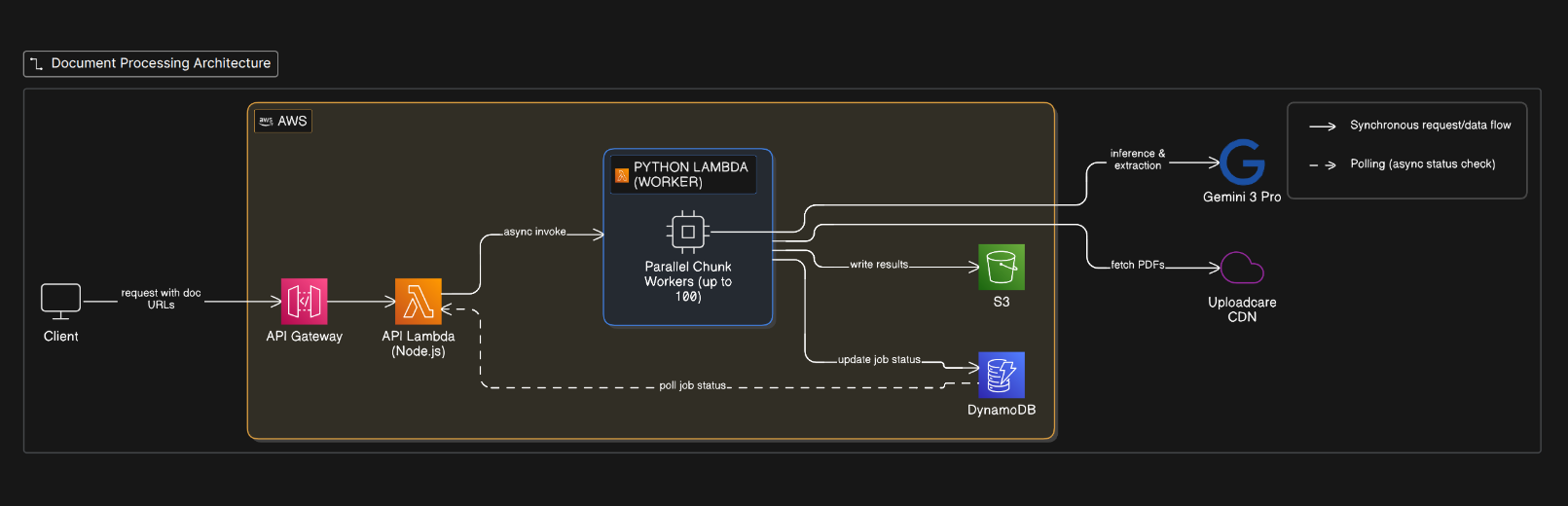
High Level Architecture:
Scalable serverless document processing pipeline: Client requests are received via AWS API Gateway, orchestrated through a Node.js API Lambda, and fanned out to parallel Python Lambda workers (up to 100) that fetch PDFs from Uploadcare CDN, run inference and extraction via Gemini 3 Pro, write results to S3, and track job status asynchronously in DynamoDB.
Sophisticated chunking strategy with parallel AI processing: Large-scale OEM documents were decomposed using a multi-stage semantic chunking strategy and processed through a parallel Gemini worker architecture, enabling 15-minute per-asset throughput at peak capacity of 1,500+ documents per day.
Google Gemini semantic analysis (beyond traditional OCR/keyword search): Rather than matching keywords, the system employed semantic classification to identify maintenance tasks regardless of document section (e.g., Safety vs. Maintenance), context-aware validation to distinguish OEM requirements from general guidance, and cross-document linking to connect knowledge across disparate sources.
NLP-based entity resolution and conflict resolution: Redundant or conflicting tasks from OEM manuals, vendor handbooks, and site procedures were deduplicated and reconciled into unified, source-attributed maintenance tasks (e.g., consolidating "inspect stator cooling ducts," "clean air passages," and "check airflow obstruction" into a single unified task with a 98.5% confidence score and a 6-month interval).
RYGB confidence framework for validated output: Extracted tasks were classified as Green (exact match to human baseline, zero intervention), Yellow (valid new findings beyond the baseline), or Red (requires tribal knowledge validation, approximately 155 activities flagged), providing auditable automation readiness scoring at 92%.
Human role redefinition: The solution redeployed consultants from manual data entry to strategic validation, enabling expert time to be focused on high-judgment Red-category tasks rather than mechanical extraction.
Technologies Used
Related Case Studies
← Back to All Case Studies
Data Science
AI-Assistance for Customer Support for Rent-to-Own Industry
A rent-to-own industry organization struggled with inconsistent customer support quality and slow response times that impacted lead conversion rates. By implementing an AI-powered chat assistance system using AWS Bedrock and retrieval-augmented generation, the organization enabled agents to receive three context-aware response suggestions within seconds during live conversations. The solution leverages historical successful conversations through semantic search and Claude Haiku 4.5, ensuring every agent delivers high-quality, proven communication strategies regardless of experience level. The serverless architecture processes thousands of requests monthly while maintaining reliability through intelligent fallback mechanisms and comprehensive monitoring.
Read More
Data Science
Artificial Intelligence - Driven Candidate Screening Revolution
JashDS revolutionized a company's hiring process by developing a GenAI-powered candidate screener that reduced time-to-hire by 50% and improved hiring outcomes. The solution leverages advanced language models to conduct dynamic, role-specific interviews, automatically generating and adapting questions based on job descriptions and candidate responses.
Read More
Data Science
Artificial Intelligence Model for Retail Shelf Monitoring
JashDS revolutionized retail shelf management for a major grocery chain by developing an AI-powered real-time monitoring system. The solution utilized advanced computer vision techniques and deep learning models to detect out-of-stock and misplaced products, significantly improving inventory accuracy and enhancing the customer shopping experience while reducing manual labor costs.
Read MoreHave a similar challenge?
Connect with us