
Letting Data Speak, AI Act!
Case Study
Data ScienceAI-Powered Customer Onboarding Agent for EdTech Mentorship Platform
Overview
An education technology company providing mentorship programs for universities and corporations faced a 6–8 week manual onboarding cycle that relied on unscalable tribal knowledge and synchronous CSM labor for each partner configuration. A conversational AI onboarding agent was deployed using a LangGraph-based multi-agent system on AWS Bedrock with RAG-powered recommendations and human-in-the-loop approval, reducing infrastructure costs to approximately $5.32 per new partner onboarding while enabling partners to self-serve 68+ program design decisions asynchronously.

About the Client
A leading education technology company specializing in mentorship program design and implementation for higher education institutions and corporate partners. The organization manages large-scale mentorship programs across universities and enterprises, requiring extensive program configuration involving branding, participant models, matching criteria, timelines, flag configurations, and customization settings for each partner institution.
The Challenge
The client's program design and onboarding process was manual, synchronous, and heavily dependent on human labor, creating a critical bottleneck in partner implementation:
- Manual Data Extraction
- No Data Reconciliation
- No Error Handling or Escalation Path
Lengthy Implementation Cycle:
Configuring new and existing partner mentorship programs required 6–8 weeks to complete, involving structured questionnaires covering branding, participation models, matching logic, timelines, flag configurations, and customization preferences.
Reliance on Tribal Knowledge:
The workflow depended heavily on Customer Success Managers (CSMs) and Community Operations Managers (COMs), whose institutional expertise was difficult to scale and transfer. Key decisions regarding program design—such as matching criteria, SSO requirements, and SFTP integrations—resided with individual team members rather than in a systematic, repeatable process.
Manual, Synchronous Communication:
Partners had to coordinate scheduling with CSMs for every design decision, making the process synchronous and slow. There was no self-service mechanism for partners to explore program options, receive data-backed recommendations, or submit design decisions asynchronously.
Scalability Constraints:
As the number of partner institutions grew, the manual process could not scale without proportionally increasing CSM headcount, threatening the company's ability to onboard new partners efficiently.
Risk of Errors and Inconsistencies:
Without automated validation, configurations were susceptible to inconsistencies (e.g., enabling mandatory participation without SSO) and missed requirements, which increased rework and delayed program launches.
Key Results
- Reduced program implementation timeline from 6–8 weeks to an estimated 1-2 hour cycle by enabling asynchronous, AI-guided program configuration
- Achieved an average infrastructure cost of approximately $5.32 per new partner onboarding and $0.87 per returning partner onboarding, ensuring cost-effective scalability to 100+ concurrent partner configurations
- Enabled partners to self-serve the entire program design workflow—covering 68+ configuration decisions across branding, participants, participation models, timelines, flag configuration, and customization—through a conversational AI agent with human-in-the-loop approval
- Reduced COM/CSM load from 6-8 hours to around 30-60 mins.
Our Solution
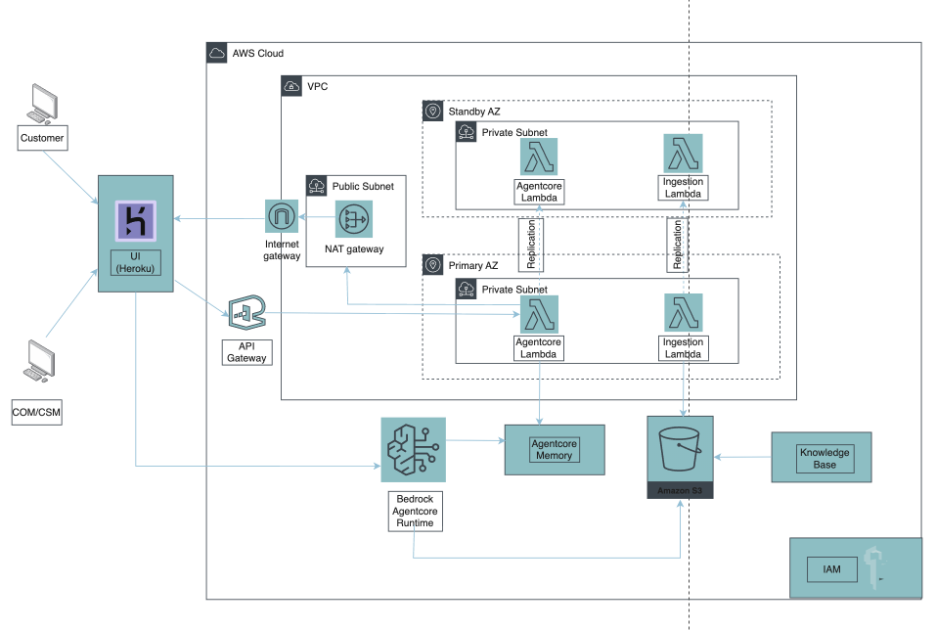
The solution involved designing and deploying a conversational AI Customer Onboarding Agent that replaced static forms with an intelligent, natural-language workflow embedded directly into the client's existing dashboard.
Key Components:
- Multi-Agent System with LangGraph: A state-machine-based architecture was built using LangGraph on AWS Bedrock AgentCore Runtime. Separate graph flows were implemented for new partners (full questionnaire) and returning partners (delta updates with section summaries). The system comprised specialized nodes—Information Extraction, Rewrite Query, RAG Retrieval, Targeted RAG Retrieval, Section Summary, and Responder—to manage conversation flow, data extraction, and recommendation generation.
- Retrieval-Augmented Generation (RAG) Pipeline: A Knowledge Base powered by Amazon S3 vector storage was integrated to provide data-backed recommendations using the client's Knowledge Center articles. The agent retrieved relevant articles in real time to answer partner questions, resolve objections, and justify design recommendations with historical performance data.
- Human-in-the-Loop Workflow: The system flagged complex decisions or partner objections for CSM/COM review rather than generating unsupervised responses. CSMs could track partner progress, review answered and unanswered questions, edit configurations, and approve final designs through a dedicated Program Designer dashboard before automatic program configuration.
- Context-Aware Conversations: The agent differentiated between new and existing customer workflows, pre-loading historical program data and institutional context for returning partners. CSMs could configure sequence-level context including organization information, previous program details, and historical performance data to inform the agent's recommendations.
- Structured Configuration UI with Visual Validation: Chat-based design decisions were translated into a structured, editable UI covering sections such as branding, participants, participation models, timelines, flag configuration, and customization. Partners could review, modify, and submit their designs, while CSMs could approve and trigger automatic program configuration—all within the existing dashboard ecosystem.
- AWS-Native, Scalable Infrastructure: The system was deployed on a secure, highly available AWS architecture within a VPC, leveraging Multi-AZ Lambda functions, API Gateway, S3, Bedrock AgentCore (runtime and memory), and IAM-based internal communication. Infrastructure was provisioned using Terraform (Infrastructure as Code), and the frontend was built in React on the existing Heroku-hosted dashboard with SigV4 authentication.
Technologies Used
Related Case Studies
← Back to All Case Studies
Data Science
AI-Assistance for Customer Support for Rent-to-Own Industry
A rent-to-own industry organization struggled with inconsistent customer support quality and slow response times that impacted lead conversion rates. By implementing an AI-powered chat assistance system using AWS Bedrock and retrieval-augmented generation, the organization enabled agents to receive three context-aware response suggestions within seconds during live conversations. The solution leverages historical successful conversations through semantic search and Claude Haiku 4.5, ensuring every agent delivers high-quality, proven communication strategies regardless of experience level. The serverless architecture processes thousands of requests monthly while maintaining reliability through intelligent fallback mechanisms and comprehensive monitoring.
Read More
Data Science
Artificial Intelligence - Driven Candidate Screening Revolution
JashDS revolutionized a company's hiring process by developing a GenAI-powered candidate screener that reduced time-to-hire by 50% and improved hiring outcomes. The solution leverages advanced language models to conduct dynamic, role-specific interviews, automatically generating and adapting questions based on job descriptions and candidate responses.
Read More
Data Science
Artificial Intelligence Model for Retail Shelf Monitoring
JashDS revolutionized retail shelf management for a major grocery chain by developing an AI-powered real-time monitoring system. The solution utilized advanced computer vision techniques and deep learning models to detect out-of-stock and misplaced products, significantly improving inventory accuracy and enhancing the customer shopping experience while reducing manual labor costs.
Read MoreHave a similar challenge?
Connect with us