Letting Data Speak, AI Act!
Case Study
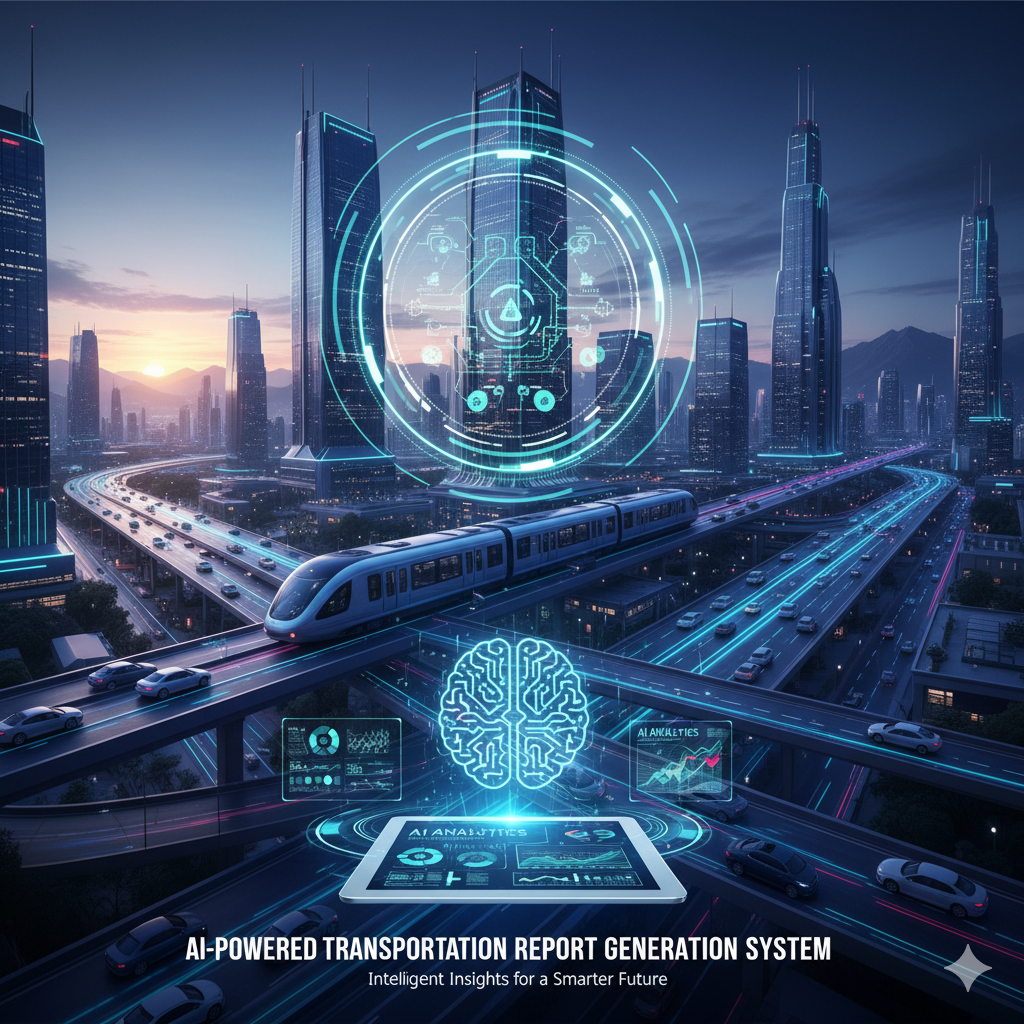
Data ScienceAI-Powered Transportation Report Generation System
Overview
This transformative AI transportation system solved a critical bottleneck in real estate development by replacing manual, consultant-driven report generation with automated, AI-orchestrated analysis. By implementing a sophisticated multi-agent architecture through AWS Bedrock and LangGraph, the system enables developers to generate professional-grade transportation reports in under an hour while maintaining the quality and comprehensiveness of traditional consulting deliverables. The platform's serverless architecture—delivering real-time API integration, intelligent data synthesis, and template-driven report generation—positions real estate developers and transportation consultants for the future of automated feasibility analysis. With measurable impacts including 80% cost reduction, 40x faster report generation, and 100% structural consistency, this solution demonstrates how AI can augment rather than replace domain expertise, allowing transportation professionals to focus on strategic analysis and recommendations while technology handles the systematic data collection and initial synthesis. The successful implementation of this POC validates the potential for AI-driven automation in specialized consulting domains, setting the foundation for broader adoption of agentic AI architectures in transportation planning and real estate development workflows.
About the Client
A leading global provider of transportation intelligence solutions that helps people make better commuting and transportation choices. The company is known for creating screens that display the real-time transportation information, and offers transit data solutions for commercial real estate, transportation demand management (TDM), and employers.
The Challenge
Scenario: A real estate developer needs a comprehensive transportation analysis for a new 200-unit residential complex. Traditional consulting requires hiring specialized transportation engineers who manually gather data from multiple sources, analyze mobility patterns, research local amenities, and compile 15+ page reports—a process taking weeks and costing thousands of dollars per report.
Traditional Approach: Transportation consultants manually collect data from various APIs, perform site visits, analyze mobility patterns, and spend days formatting reports with executive summaries, detailed analysis sections, and supporting data tables. Each report is essentially built from scratch, with consultants repeatedly performing similar data collection tasks across different projects.
The Real Problem: This manual process creates bottlenecks for developers who need rapid feasibility assessments for multiple potential sites. The high cost and time investment often delays decision-making, while human consultants struggle to maintain consistency across reports and may miss relevant data sources. The lack of standardization also makes it difficult to compare analyses across different locations.
Root Cause: Traditional transportation consulting lacks systematic data orchestration and standardized analytical frameworks. The process treats each report as a unique endeavor rather than leveraging repeatable AI-driven workflows that can consistently gather, analyze, and synthesize transportation data from multiple APIs into professional-grade reports.
Key Results
- Report Generation & Quality:
- Reduced report generation time from 2-3 weeks to under 1 hour through automated data collection and synthesis
- Achieved 100% consistency in report structure and formatting by using sample report templates as structural guides
- Eliminated manual data gathering errors by implementing automated API integrations with real-time validation
- Cost & Operational Efficiency:
- Reduced transportation analysis costs by 80% through AI automation, making feasibility studies accessible for smaller developers
- Cut consultant workload by automating routine data collection tasks, allowing focus on high-value strategic analysis
- Enabled concurrent analysis of multiple locations, supporting rapid site comparison and selection
- Technical & Scalability Achievements:
- Implemented serverless AWS architecture supporting unlimited concurrent report generation with zero infrastructure management
- Achieved sub-second response latency for all API integrations (Mobility Score, Walk Score, Google Places, Yelp)
- Processed location data with 100% accuracy from both street addresses and latitude/longitude coordinates
- Enabled real-time progress tracking through Server-Sent Events (SSE) streaming for transparent user experience
- Extended Impact: Industry Transformation:
- Developer ROI: Enabled rapid feasibility analysis across multiple sites, accelerating project pipeline decisions
- Consultant Productivity: Freed transportation engineers from routine data collection to focus on strategic recommendations and complex analysis
- Market Access: Made professional transportation analysis accessible to smaller developers previously priced out of consulting services
Our Solution
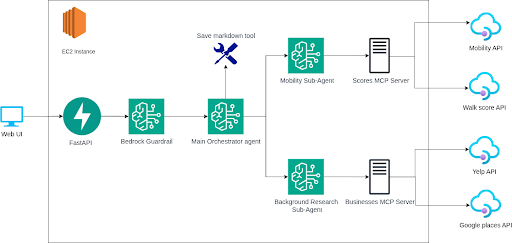
The team built a comprehensive, multi-agent AI system with four integrated components orchestrated through AWS Bedrock:
Core Components:
1. Intelligent Agent Orchestration Engine
- Main LLM Orchestrator: AWS Bedrock Claude 3.7/4.0 supervisor agent coordinating specialized sub-agents through structured workflows
- Phased Execution Logic: Automated progression through data collection → synthesis → validation → report generation phases
- Context-Aware Coordination: Maintains session state and context across multiple API calls and agent interactions
- Dynamic Task Allocation: Distributes data collection tasks to appropriate sub-agents based on information dependencies
2. Specialized Agent Architecture
- Mobility Scores Agent: Migrated from OpenAI prototype to AWS Bedrock, integrates with proprietary Mobility Score API and Walk Score API for transportation accessibility analysis
- Business Research Agent: Leverages Google Places and Yelp APIs to gather comprehensive amenity and commercial facility data
- Orchestrator Agent – Manages the Mobility Scores Agent and Business Research Agent, while also handling report synthesis and quality validation tasks to ensure completeness and structural alignment with templates.
3. Context-Aware Personalization System
- scores_server: Dedicated MCP server exposing mobility_score (MobilityScore API) and walk_score (Walk Score API) tools with robust parameter validation
- businesses_server: Specialized MCP server providing google_places (Google Places New API) and yelp (Yelp Fusion) integration with comprehensive business data retrieval
- API Orchestration: Centralized management of external API calls with error handling and response validation
- Data Normalization: Consistent data structure conversion across different API response formats
4. Automated Report Generation & Delivery System
- Template-Driven Structure: Uses uploaded sample reports (PDF) to extract formatting, section ordering, and content structure requirements
- Dynamic Content Synthesis: Combines API data into cohesive narrative following transportation planning best practices
- Multi-Format Output: Generates both markdown and interactive HTML reports with embedded data visualizations
- Version Management: Automated report versioning under reports/{thread_id}/ directory structure
Technologies Used
Related Case Studies
← Back to All Case Studies
Data Science
AI-Assistance for Customer Support for Rent-to-Own Industry
A rent-to-own industry organization struggled with inconsistent customer support quality and slow response times that impacted lead conversion rates. By implementing an AI-powered chat assistance system using AWS Bedrock and retrieval-augmented generation, the organization enabled agents to receive three context-aware response suggestions within seconds during live conversations. The solution leverages historical successful conversations through semantic search and Claude Haiku 4.5, ensuring every agent delivers high-quality, proven communication strategies regardless of experience level. The serverless architecture processes thousands of requests monthly while maintaining reliability through intelligent fallback mechanisms and comprehensive monitoring.
Read More
Data Science
Artificial Intelligence - Driven Candidate Screening Revolution
JashDS revolutionized a company's hiring process by developing a GenAI-powered candidate screener that reduced time-to-hire by 50% and improved hiring outcomes. The solution leverages advanced language models to conduct dynamic, role-specific interviews, automatically generating and adapting questions based on job descriptions and candidate responses.
Read More
Data Science
Artificial Intelligence Model for Retail Shelf Monitoring
JashDS revolutionized retail shelf management for a major grocery chain by developing an AI-powered real-time monitoring system. The solution utilized advanced computer vision techniques and deep learning models to detect out-of-stock and misplaced products, significantly improving inventory accuracy and enhancing the customer shopping experience while reducing manual labor costs.
Read MoreHave a similar challenge?
Connect with us