
Letting Data Speak, AI Act!
Case Study
Data EngineeringReal-Time AI Chatbot Platform’s Lambda to ECS Migration
Overview
An AI chatbot startup faced critical Lambda performance issues including 100% memory utilization causing crashes, 7-8 second cold starts,Scalability issues where in multiple concurrent users using this application concurrently faced issues to use the application which includes laginess taking too much time to get the response, application crashing and completely non-functional WebSocket group chat due to protocol incompatibility between Socket.IO frontend and API Gateway WebSocket backend. Through a 4-week POC engagement, we successfully containerized Lambda functions to ECS Fargate, conducted systematic JMeter load testing up to 1,000 concurrent users, and delivered complete Terraform Infrastructure-as-Code, achieving 94% response time reduction (to sub-1-second), 100% cold start elimination, 0% error rate, and validated linear horizontal scalability while providing all technical documentation and architecture recommendations for production migration decision-making.

About the Client
A technology startup in the AI/ML industry developing an intelligent conversational AI platform. The platform provides real-time group chat collaboration features powered by machine learning classification models. This case study demonstrates how serverless Lambda infrastructure can be successfully migrated to container-based ECS Fargate to resolve critical performance issues affecting ML-intensive workloads.
The Challenge
The client’s Lambda-based backend faced three critical architectural failures threatening platform viability:
- Memory Constraint Crisis: The Lambda function consistently hits 100% memory utilization at the 2048 MB limit when loading the ML classification model. This caused frequent out-of-memory crashes, function throttling, and complete service unavailability during peak periods. The ephemeral nature of Lambda meant the model had to be reloaded from S3 on every cold start.
- Severe Cold Start Latency: Users experienced 7-8 second delays on initial requests as Lambda reloaded the entire ML model from S3 into memory. For a real-time chat application where sub-second responsiveness is expected, this created an unacceptable user experience driving customer complaints and churn.
- Real-Time Communication Architecture Mismatch: The group chat feature was completely non-functional. The frontend used a Socket.IO client while the backend relied on API Gateway WebSocket, creating fundamental protocol incompatibility. WebSocket connections failed with timeout errors within seconds, and Lambda’s stateless execution model proved incompatible with WebSocket’s requirement for persistent long-lived connections. When User A sent messages, User B never received them due to lack of room-based broadcast logic.
Business Impact: Without resolution, the client faced customer churn,scalability issues, potential platform shutdown due to lack of core functionality. A structured POC was mandated to validate whether ECS Fargate could solve these issues before committing to full production migration.
Key Results
- Eliminated 100% of Cold Starts: Migrated to persistent ECS Fargate containers that maintain the 500 MB RoBERTa model in memory continuously, completely removing the 7-8 second initialization delay and providing instant response to all user requests.
- Reduced Average Response Time by 94%: Achieved sub-1-second response times (964 ms for login, 1,045 ms for ML classification, 1,204 ms for chat) for 1,000 concurrent users through JMeter load testing, down from 17+ seconds in the Lambda architecture.
- Validated Linear Horizontal Scalability: Demonstrated near-perfect scaling efficiency where increasing from 1 to 6 ECS containers reduced response times proportionally (17.6s → 1.0s for 500 users) while maintaining stable 73% CPU utilization with 27% headroom for traffic spikes.
Our Solution
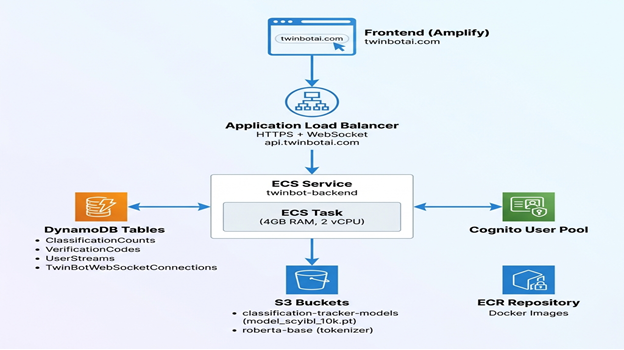
The team executed a structured 4-week POC following agile methodology with three specialized roles (Technical Lead, Cloud Engineer, Backend Engineer)
Architecture Design and Infrastructure Foundation - Analyzed the existing Lambda function to document the existing architecture and memory bottlenecks. Designed ECS Fargate architecture with direct Application Load Balancer routing, rejecting the alternative API Gateway + VPC Link + NLB approach due to 10-20ms higher latency and increased operational cost. Created comprehensive Terraform Infrastructure-as-Code templates for ECS cluster configuration , ALB , security groups, IAM roles, and auto-scaling policies.
- Containerization - Developed optimized Dockerfiles using python:3.10-slim base image with multi-stage builds, baking the 500 MB RoBERTa model directly into container images to eliminate runtime S3 downloads. Refactored Lambda event handlers to Flask REST API endpoints and replaced API Gateway WebSocket with Flask-SocketIO using eventlet async workers. Pushed all versioned container images to Amazon ECR.
- Performance Test Suite Development - Provisioned dedicated JMeter infrastructure and created comprehensive test plans simulating complete user journeys across login, classification, and chat APIs. Developed automated test execution framework with configurable thread groups for 100, 500, and 1,000 concurrent users. Created test data generation scripts producing realistic message payloads and user credentials for parameterized testing with CSV data sets.
- Optimization, Validation, and Documentation - Executed systematic performance testing across 16 configurations varying ECS container count (1-6), Gunicorn workers (1-4), and threads per worker (4-16). Identified CPU as the primary bottleneck for ML inference and discovered Python’s Global Interpreter Lock (GIL) prevents thread-based parallelism, requiring multi-process workers. Determined optimal configuration: Workers = CPU cores with 8 threads per worker, providing best throughput/resource balance. Validated linear scalability with 1,000 users achieving 1.1s response time at 73% CPU. Delivered complete Terraform templates, technical documentation with architecture diagrams, and performance analysis reports.
- Critical Bug Resolution - Proactively identified and fixed few production-blocking bugs during POC validation: LocalStorage key mismatch breaking “My Chats” navigation, message alignment issues requiring userId in WebSocket payloads, JWT error handling ,, missing UI icons (notification bell, user placeholder), sender name display in group chat, and WebSocket authentication flow corrections.
- POC Deliverables Achieved - Container Infrastructure (1 Lambda function containerized and pushed to ECR), AWS Infrastructure as Code (complete Terraform templates), Performance Test Suite (JMeter scripts, test data generation, automated execution framework), Performance Test Results (baseline and load test reports with response time analysis), and comprehensive Documentation (technical guides, architecture diagrams, knowledge transfer sessions).
Technologies Used
Related Case Studies
← Back to All Case Studies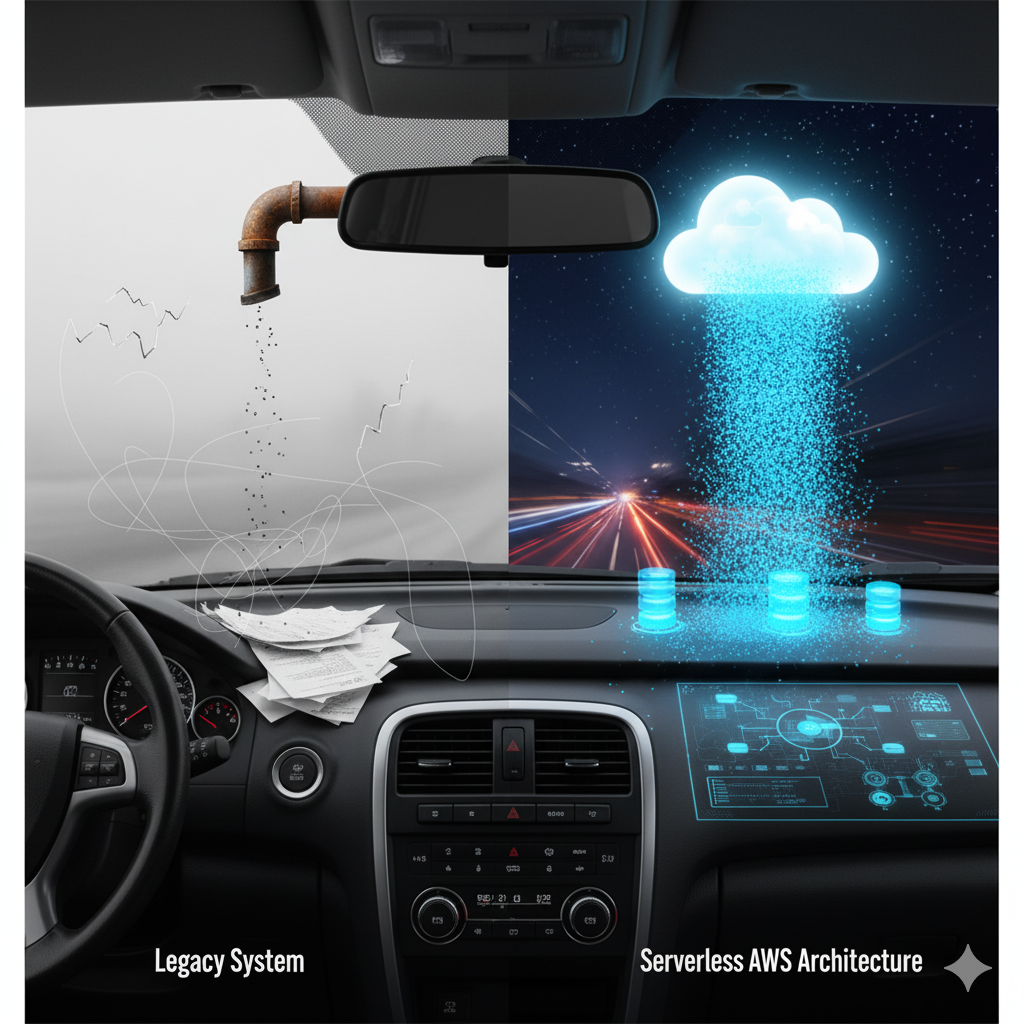
Data Engineering
Scalable Serverless AWS Architecture for Dash Cam Data Processing
JashDS developed a scalable serverless AWS architecture for a dash cam technology company, replacing their legacy FTP system with a comprehensive solution featuring ESE Fargate, Lambda functions, S3 storage, SQS and Kinesis queuing to handle video footage and telemetry data processing. The implementation supported a projected tenfold increase in data volume while providing automated scaling, reduced latency, and improved reliability for their new dash cam product line through modern cloud-native data processing pipelines utilizing Aurora RDS, ECS Fargate, and site-to-site VPN connectivity.
Read More
Data Engineering
Migrating Data from EC2 to RDS and RDS to Redshift
JashDS successfully modernized a digital marketing company's data infrastructure by migrating from 20 distributed EC2-hosted MariaDB instances to a centralized Aurora MySQL RDS cluster, followed by real-time data replication to Redshift for analytics, resulting in 20% operational cost reduction and 15% query performance improvement. The comprehensive solution leveraged AWS DMS for seamless data migration, implemented automated backup and recovery mechanisms, and established a scalable data warehouse architecture that separated analytical workloads from operational systems.
Read More
Data Engineering
Azure to AWS SaaS Platform Migration
An EdTech SaaS company migrated its entire Azure-hosted student risk monitoring platform to AWS in 9 weeks — lifting and shifting 17 VMs, 12 PostgreSQL databases, and multiple application services with zero disruption to school district operations. The solution leveraged Terraform, AWS Control Tower, and a fully automated CI/CD pipeline to deliver a scalable, cost-optimized cloud foundation built for rapid expansion.
Read MoreHave a similar challenge?
Connect with us