
Letting Data Speak, AI Act!
Case Study
Data ScienceAI Driven Course Curriculum Map Generation and Searching System
Overview
A fully accredited nonprofit medical school automated its curriculum mapping process using an AI-driven system on AWS. The solution processed 22+ courses end-to-end — from raw IMSCC files to prerequisite-aware, AAMC-aligned curriculum maps — significantly reducing manual effort and improving consistency across its medical education program.

About the Client
A fully accredited, nonprofit medical school training physicians for practice in the United States and Canada. The institution positions itself as an exceptional alternative for qualified students who face limited medical school seats in North America. The client intended to utilize Generative AI technologies on Amazon Web Services (AWS) to implement an AI-driven system for ingesting IMSCC (IMS Common Cartridge) files and automatically generate a course curriculum map aligned to the AAMC framework.
The Challenge
The client faced a time-intensive and inconsistent manual process for mapping course content to the AAMC (Association of American Medical Colleges) competency framework. With 22 courses and IMSCC files containing heterogeneous content — HTML pages, PDFs, PowerPoint slides, QTI assessments, and images — manual mapping was both error-prone and unscalable. Some IMSCC files exceeded 1.3 GB in size with 200+ resources, requiring processing times far beyond what Lambda's 15-minute execution limit could accommodate. The platform also lacked a searchable, structured store for generated curriculum maps and had no mechanism for aligning content across courses to surface prerequisite dependencies.
Key Results
- Delivered a fully automated, end-to-end curriculum mapping pipeline processing 22+ courses from raw IMSCC files to structured, AAMC-aligned curriculum maps
- Achieved intelligent AAMC competency alignment across all four domains: Interpersonal, Intrapersonal, Thinking and Reasoning, and Science Competencies
- Solved large-file processing challenge — files up to 1.3 GB processed within Lambda's 15-minute timeout using dynamic batch sizing and Step Functions orchestration
- Implemented prerequisite-aware module sequencing via two-pass dependency analysis, ensuring correct course ordering in final curriculum maps
- Deployed hybrid semantic and keyword search API over all processed curriculum content, accessible via API Gateway
- Built automatic model fallback from Claude Sonnet 4.5 to Claude Sonnet 4 when daily Bedrock token quotas are reached, ensuring pipeline continuity
- Delivered full infrastructure-as-code using Terraform across 50+ AWS resources for repeatable, multi-environment deployment
Our Solution
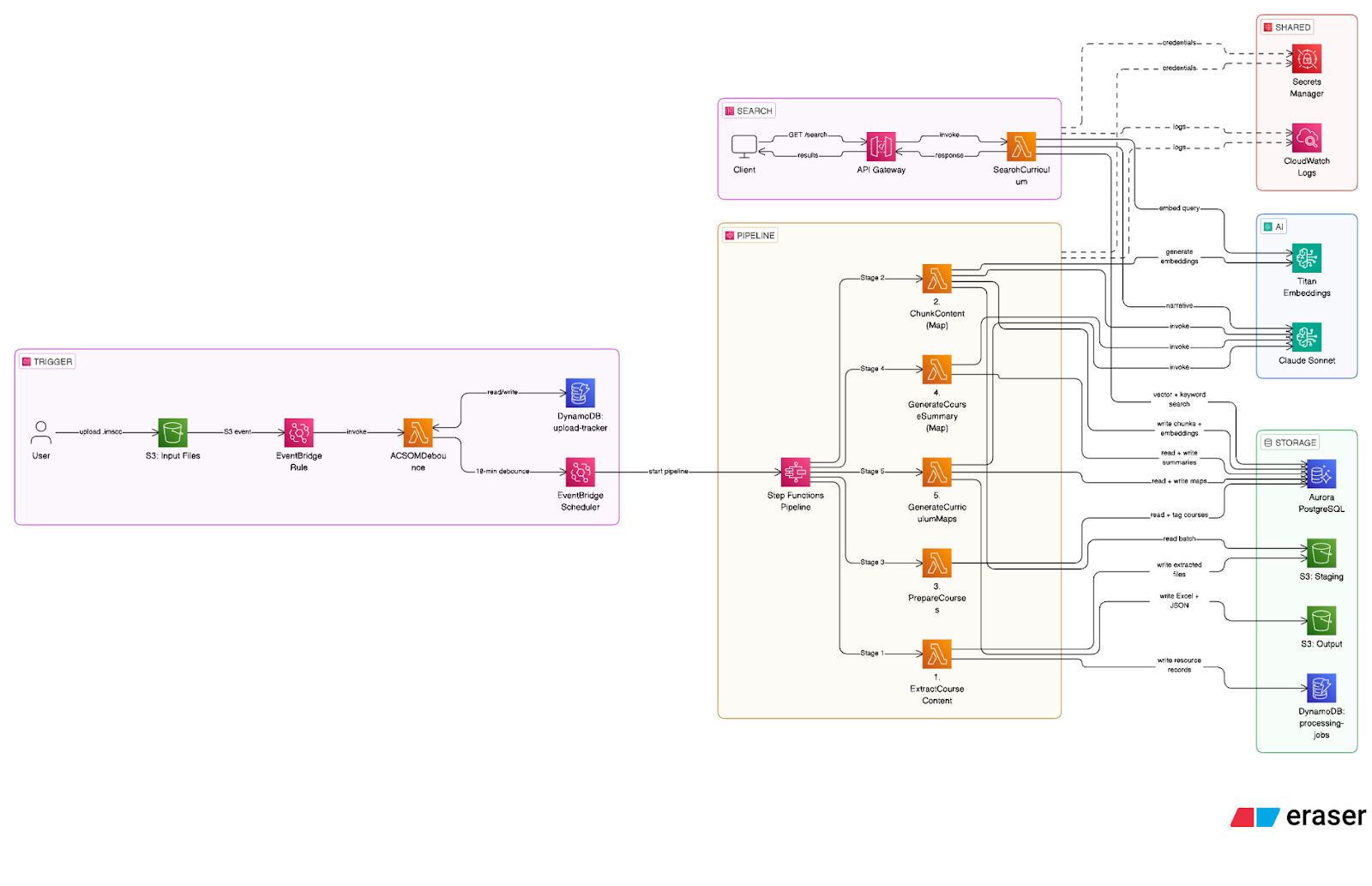
Event-Driven Batch Processing Pipeline
- Built a fully serverless, event-driven pipeline on AWS that processes entire cohorts of courses once to generate structured curriculum maps — not a chatbot or RAG system
- IMSCC files uploaded to S3 automatically trigger the pipeline after a 10-minute debounce window, ensuring all cohort files are present before processing begins
Content Extraction and Hierarchical Chunking
- Unpacked and parsed IMSCC files across all content types: HTML, PDF, PPTX, DOCX, QTI/XML, and images (via Claude vision OCR)
- Applied hierarchical chunking at 800 tokens with 100-token overlap across three levels: Course → Module/Unit → Resource/Item
- Large PDFs split into 25-page parts; images compressed to reduce Bedrock token usage by 60–70%
- Generated Titan Embed Text v2 embeddings (1536 dimensions) per chunk, stored in Aurora PostgreSQL with pgvector
AAMC Competency Mapping and Course Summarization
- Claude extracted learning objectives per resource and mapped them to the four AAMC competency domains during chunking
- Generated structured JSON course summaries capturing key topics, prerequisite topics, AAMC domain coverage percentages, and module breakdowns
Two-Pass Curriculum Map Generation
- Pass 1: Claude built a prerequisite dependency graph by cross-referencing each course's topics against others
- Pass 2: Dependency map injected as ordering constraints to generate a correctly sequenced module blueprint
- Pass 3: Two full curriculum maps generated from the blueprint — Core (required competencies) and Supplementary (additional learning) — output as Excel and JSON to S3
Hybrid Semantic Search API
- Hybrid search combining Titan v2 vector similarity and PostgreSQL ILIKE keyword matching; results appearing in both ranked highest
- Claude generates a natural language narrative over top results; exposed via API Gateway GET /search with cohort-level filtering
Step Functions Orchestration for Scale
- Step Functions orchestrated the pipeline with parallel Map states — up to 5 courses and 3 batches per course concurrently
- ThreadPoolExecutor (3–5 workers) within each Lambda maximized Bedrock API throughput within the 15-minute timeout ceiling
- Built-in retries, checkpoint recovery, and idempotent reprocessing ensured resilience across long-running cohort runs
Technologies Used
Related Case Studies
← Back to All Case Studies
Data Science
AI-Assistance for Customer Support for Rent-to-Own Industry
A rent-to-own industry organization struggled with inconsistent customer support quality and slow response times that impacted lead conversion rates. By implementing an AI-powered chat assistance system using AWS Bedrock and retrieval-augmented generation, the organization enabled agents to receive three context-aware response suggestions within seconds during live conversations. The solution leverages historical successful conversations through semantic search and Claude Haiku 4.5, ensuring every agent delivers high-quality, proven communication strategies regardless of experience level. The serverless architecture processes thousands of requests monthly while maintaining reliability through intelligent fallback mechanisms and comprehensive monitoring.
Read More
Data Science
AI-Powered Knowledge Access Platform for Rent-to-Own Industry
A rent-to-own industry organization struggled with fragmented information access across public industry knowledge bases and private operational databases, forcing users to manually search multiple systems and preventing timely, data-driven decision-making. By implementing a dual-pipeline RAG architecture with AWS Bedrock, Amazon OpenSearch, and intelligent query routing, the solution reduced knowledge base query response times to 5-8 seconds and enabled natural language access to both public and private data sources through a unified conversational interface powered by Claude Sonnet 4 and Titan Embeddings v2.
Read More
Data Science
AI-Powered Misconception Detection for Science Education
An education technology company needed to automate the generation of misconception-aware, grade-appropriate feedback for K-12 science assessments at scale, replacing a manual process that could not keep pace with content demand. A serverless, AI-powered system leveraging AWS Lambda, Amazon Bedrock with Claude Sonnet 4.5, and tool-enforced structured output was deployed, enabling automated feedback generation at approximately $0.016 per question with 100% schema-validated consistency across all grade levels.
Read MoreHave a similar challenge?
Connect with us